Lane keeping, automatic emergency braking, surround view, parking assist: every one of these ADAS functions depends on cameras that see clearly in rain, heat, vibration and car-wash spray. The lens and image sensor get the attention. Yet the part that keeps them working for the life of the vehicle is often a small piece of metal: the ADAS camera housing.
Behind the cameras sits a second metal enclosure, the ECU that processes and fuses their images. Both parts are frequently made by high-pressure aluminum die casting. In this post we look at why, from the perspective of a die caster rather than a camera designer.
Table of Contents
What an ADAS camera housing has to do
An automotive camera is expected to operate across roughly -40°C to +85°C while handling vibration, shock and repeated thermal cycling. An ADAS camera housing carries four jobs at once.
1. Move heat away from the image sensor. Image sensors and their processors generate heat, and image noise rises as they get hotter. A common design dispenses thermal interface material between the circuit board and the metal walls, so the ADAS camera housing itself becomes the heat spreader. Aluminum’s thermal conductivity is the reason it is chosen over plastic here.
2. Shield against electromagnetic interference. A modern vehicle is full of radar, motors, inverters and high-speed data lines. A continuous metal enclosure acts as a shield around the sensor board, protecting image data integrity.
3. Hold the lens on axis. Camera makers use active alignment to position the lens to the sensor at pixel level. That alignment only lasts if the ADAS camera housing stays dimensionally stable through heat, cold and vibration. Datum faces, lens bores and board-mounting bosses must stay where the drawing put them, part after part.
4. Stay sealed. Exterior cameras commonly target IP67, and IP69K where high-pressure, high-temperature washing is expected. Water inside a camera means fogging behind the lens and a lost camera function. The sealing face, whether for an O-ring, a glue bead or a laser-welded rear cover, must be flat and free of surface porosity.
Die casting delivers all four in a single near-net-shape ADAS camera housing: thin walls, integrated mounting ears and bosses, and consistent geometry at automotive volumes. Patent literature from camera makers regularly specifies die-cast aluminum housings, often in high-silicon alloys such as A360 or A413 chosen for fluidity in thin sections. (For alloy trade-offs, see our post on the best aluminium alloys for die casting.)
The ECU behind the cameras
Camera images feed an ECU that processes inputs from several cameras and produces fused views for the driver or the ADAS logic. Its enclosure faces the same demands as the camera housing, at a larger scale and with a bigger heat load.
A typical air-cooled ECU housing is a die-cast aluminum base or cover that combines:
- integrated heat-sink fins or ribs over the processor area, cast in one piece with the enclosure
- raised thermal pads that meet the board’s hot spots through a thin layer of interface material
- a continuous metal shell for EMI shielding
- a seal groove for an O-ring or form-in-place gasket
- connector openings, mounting ears and screw bosses located precisely to the board
Die casting is not the answer for every ECU. As centralized ADAS domain controllers move to higher-power processors, some designs switch to liquid-cooled housings machined from wrought aluminum and sealed by friction stir welding. The boundary is useful to know: finned, air-cooled ECU and camera-controller housings are a natural fit for die casting, while liquid-cooled cold-plate structures usually follow a different process.
Design and production points that decide quality
ECU and ADAS housings have to deliver EMI shielding, structural integrity and tight tolerances at the same time. From the casting side, these are the points we discuss most with engineers:
- Wall thickness and flow. Uniform walls fill evenly and shrink evenly. Abrupt thick sections near the lens bore are a common source of shrinkage and distortion.
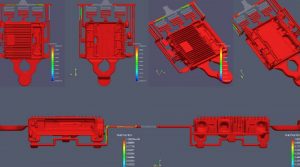
- Porosity where it matters. Sealing faces, threaded holes and thermal pads are machined after casting, which can open subsurface pores. Careful gate and overflow placement keeps these zones dense. See our post on controlling porosity with production parameters.
- Machining datums. Lens bores, sensor-board seats and sealing faces are usually finish-machined. Planning casting datums together with the machining fixture is what keeps the optical axis repeatable.
- Surface finishing. Exterior housings need corrosion protection against road salt and washing chemicals, typically through e-coating, powder coating or conversion coating. See post-casting finishing processes.
- Small metal details. Brackets, connector shells and latches around the camera can be candidates for zinc multi-slide die casting when they are small and need fine detail.
Lessons from a neighboring industry
Much of what goes into an ADAS camera housing is familiar to us from another kind of camera. For years, EKO has die cast aluminum housings for network security cameras sold worldwide. Those products face the same core requirements: heat out of the sensor, a sealed enclosure for outdoor use, and a lens bore that stays true after machining. Automotive cameras add a wider temperature range, stronger vibration and the traceability that IATF 16949 demands.
The takeaway for anyone specifying an ADAS camera housing or ECU enclosure: involve the die caster at the design stage. Wall thickness, gate location and machining datums are cheapest to fix on the drawing and most expensive to fix in the tool.
EKO Metal Industries is an IATF 16949-certified die casting, CNC machining and sheet metal manufacturer in Penang, Malaysia. We welcome connections with engineers working on automotive electronics.