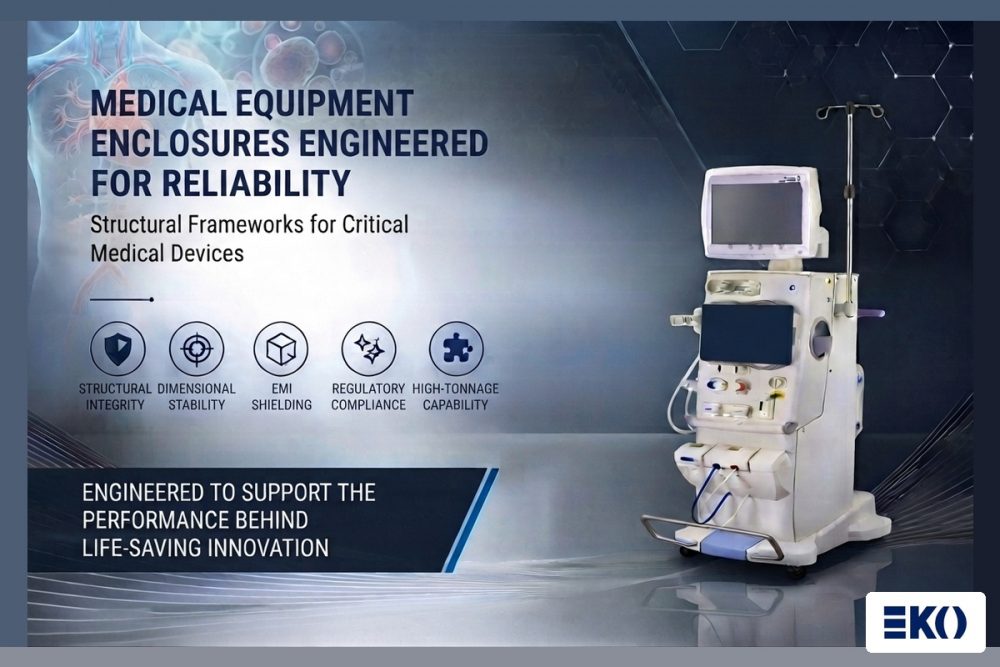
Aluminum die casting medical equipment reliability often comes down to what’s invisible to the patient — the structural skeleton inside large, fixed-installation devices like dialysis systems, blood processing equipment, and diagnostic imaging machines. These frames carry the full weight of the unit, house internal plumbing and electronic modules, and have to hold their shape through years of daily use without warping.
Table of Contents
Why Aluminum Die Casting Medical Equipment Frames Need High Tonnage
Unlike a small handheld instrument, a floor-standing or cart-based medical device puts real structural demands on its internal frame:
- Load-bearing strength — the chassis has to support the full weight of pumps, displays, tubing systems, and any moving components without flexing, often while the unit is repeatedly wheeled between rooms or repositioned at bedside
- Dimensional stability — internal modules (sensors, pump assemblies, display units) need to mount to precise reference points, so the frame can’t shift or warp over the device’s service life, which can run well over a decade in a hospital setting
- EMI shielding — densely packed medical electronics benefit from a metal enclosure that shields against interference, which aluminum provides inherently without requiring a separate shielding layer
High-tonnage aluminum die casting addresses all three by producing a single, near-net-shape structural part instead of an assembled framework of multiple smaller pieces.
Where This Shows Up in Real Equipment
Documented manufacturing case work in the medical equipment space bears this out. One U.S.-based die casting supplier describes producing cart bases, pump enclosures, and structural components specifically for MRI machines and scanners — citing low porosity and fine grain structure as what makes aluminum castings suited to that application. The same structural logic applies across large diagnostic and therapeutic equipment more broadly: a base frame that anchors the unit, a chassis shell that houses and protects internal components, and smaller enclosure castings for handheld or peripheral elements of the same system.
This is the space EKO’s high-tonnage aluminum die casting capacity operates in — producing large-format structural frames and enclosure components used in medical equipment manufacturing, including base chassis castings and multi-panel housing structures for fixed-installation devices.
Design for Manufacturing at High Tonnage
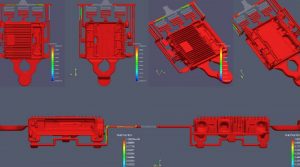
Large structural castings carry different DFM considerations than small precision parts. Wall thickness needs to stay uniform across a much larger surface area to avoid warping during cooling, rib placement has to reinforce load paths without adding unnecessary mass, and draft angles matter more at scale since a poorly drafted large casting is far more costly to rework than a small one. Getting these right at the design stage is what determines whether a structural frame holds its tolerances through years of field use — and for equipment that stays in service for a decade or more, that upfront design discipline matters more than it does for consumer products with shorter replacement cycles.
Why Certification Matters for This Application
Medical equipment manufacturing isn’t a market a supplier can enter casually. Industry guidance is direct on this point: die cast components used in medical equipment are expected to meet both industry and regulatory standards, including ISO 9001 and ISO 13485 certification, regardless of whether the part is structural or patient-contact. For structural components specifically, that certification isn’t about the metal itself — it’s about the quality system behind how consistently that metal gets cast, batch after batch, for equipment that can’t afford a structural failure in the field.
EKO’s facilities hold ISO 9001, IATF 16949, and ISO 13485 certification, which is the quality system foundation this kind of structural work in the medical equipment supply chain depends on. For buyers evaluating a supplier for this category of part, that certification set is usually the first checkpoint, well before tooling or pricing discussions even begin.