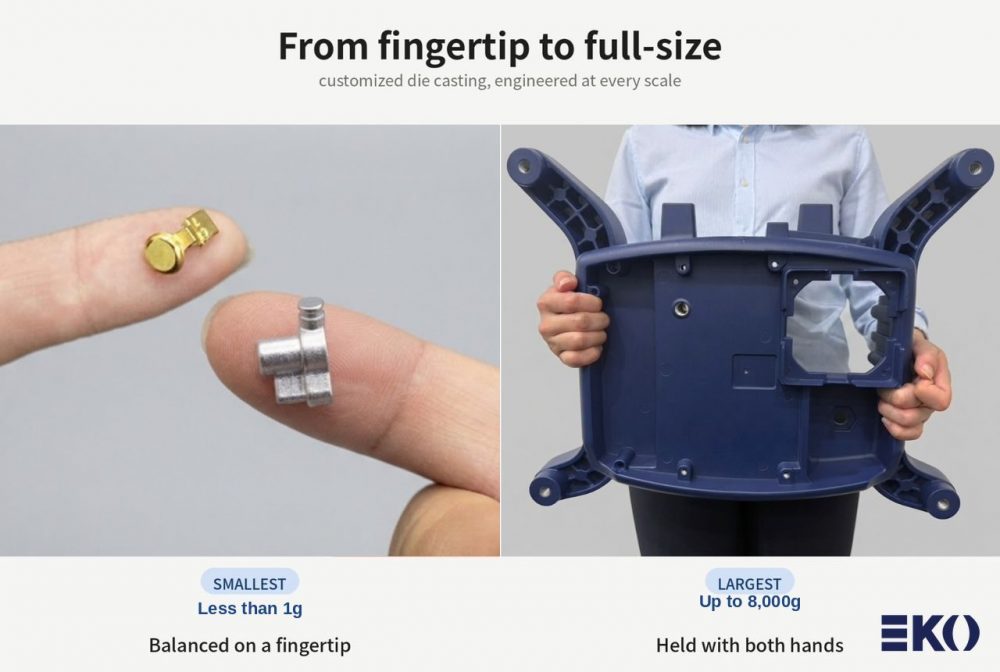
In precision manufacturing, die casting capability across scale range is an easy thing to overlook — but it’s one of the clearest indicators of supply chain stability. At EKO, that range spans less than 1 gram to 8,000 grams — from a zinc alloy structural component small enough to balance on a fingertip, to an aluminum structural frame large enough to require both hands to hold.
At first glance, these look like two completely different tiers of manufacturing capability. At EKO, they’re two ends of the same integrated production system: high-pressure die casting (HPDC), CNC machining, and sheet metal fabrication.
Why Die Casting Capability Across Scale Range Matters to Customers
Most customers run into the same problem early in a project: a supplier that excels at small precision parts often isn’t equipped for large structural components, and a supplier built for large structural work often can’t hold the tight tolerances that precision parts demand. The usual outcome is that a single product line ends up split across two or three different suppliers — more coordination overhead, inconsistent quality standards across vendors, and a longer overall development cycle.
Rather than leaving customers to split their supply chain between “precision small parts” and “large structural components,” EKO builds both capabilities into a single system:
- Multi-slide die casting for thin-wall, geometrically complex small components
- Large-format aluminum HPDC with downstream CNC machining for structural frames that need to meet both load-bearing and dimensional tolerance requirements
- IATF 16949, ISO 9001, ISO 13485, and ISO 14001 certifications applied consistently across the full size range, so quality doesn’t vary with part size
What That Range Means in Practice
That kind of range isn’t just a marketing number — it reflects real differences in tooling, machine tonnage, and process control. Small precision components at the lighter end typically require multi-slide die casting tooling to hold tight tolerances on thin-wall, geometrically complex geometries. Components at the heavier end require larger-tonnage HPDC machines, longer flow-length control, and downstream CNC machining to meet both structural load-bearing and dimensional accuracy requirements.
Maintaining consistent quality certification (IATF 16949, ISO 9001, ISO 13485, ISO 14001) across that entire range — rather than only at one end — is what allows EKO to support a customer’s full product line without asking them to qualify a second or third supplier.
One Die Casting Supply Chain, Two Extremes
That’s the story behind this image — not a claim of “we can do everything,” but a concrete illustration: from precision zinc components under 1 gram to aluminum structural frames up to 8,000 grams, EKO covers a product line without splitting it across multiple suppliers.
Whether your project sits closer to the fingertip end or the full-size end of that range — or spans both — EKO’s die casting, CNC machining, and sheet metal fabrication capabilities are built to cover it under one roof. Get in touch to discuss your component requirements.