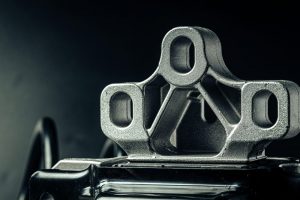
The rise of AI has changed what a data center looks like on the inside. Racks that once ran on air cooling now carry GPUs and semiconductor accelerators dense enough to need direct liquid cooling — CDUs (Coolant Distribution Units), pump housings, heat sink bases, and manifold structures that all have to move heat and coolant reliably, at scale, without leaking.
Behind almost every one of these components sits the same manufacturing question: how do you produce a structural, thermally efficient, leak-proof part economically at the volumes AI infrastructure now demands? For aluminum and zinc structural components, the answer is increasingly high-pressure die casting (HPDC).
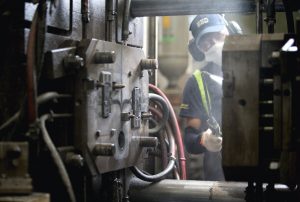
High-pressure die casting forces molten aluminum or zinc into a steel mold under high pressure, producing parts with tight dimensional tolerances and smooth as-cast surface finishes straight out of the tool. For data center cooling components, three properties matter most:
- Thermal performance
Aluminum alloys used in HPDC offer strong thermal conductivity, which matters directly for heat sink bases and CDU housings where heat needs to move efficiently away from GPUs and semiconductor packages.
- Dimensional precision at volume
Liquid cooling only works if it doesn’t leak. HPDC’s repeatable tolerances make it well suited to parts with mating surfaces, seal grooves, and internal cooling channels that need to hold consistent dimensions across thousands of units — critical as AI server deployments scale from prototypes to production runs.
- Structural integrity in a compact footprint
Rack space in AI data centers is expensive. HPDC allows relatively thin, complex wall geometries — ribs, bosses, mounting features — to be cast in a single shot, reducing the need for secondary assembly while keeping components lightweight relative to their strength.
Where This Shows Up in a Rack
Several structural categories in modern AI/semiconductor cooling infrastructure are well matched to HPDC:
- CDU and pump housings
structural enclosures that need precision mating surfaces and internal passages for coolant flow
- Heat sink bases
where thermal conductivity and surface finish directly affect cooling performance
- Rack-mount structural brackets and hardware
parts that need strength and consistent fit across large deployment volumes
- Fan frames and housings
structural components supporting airflow within hybrid air/liquid cooling designs
As data centers add more direct-to-chip and immersion cooling to support higher-density AI and semiconductor workloads, the number of precision aluminum and zinc structural parts in each rack tends to grow — not shrink.
Why This Matters for Sourcing
Data center OEMs and cooling system integrators evaluating new suppliers are often weighing the same trade-off: tooling cost and lead time up front, against per-unit cost and consistency at scale. HPDC’s economics favor programs with meaningful production volume — which is exactly the trajectory AI infrastructure is on.
For component qualification, the practical requirements tend to be consistent: IATF 16949 or ISO 9001 quality systems, dimensional repeatability across production lots, and in some cases leak-proof sealing validation (such as IP-rated testing) for parts that carry coolant.
EKO Metal Industries is a Malaysia-based precision manufacturer specializing in high-pressure die casting (aluminum and zinc), CNC machining, and sheet metal fabrication, IATF 16949 / ISO 9001 / ISO 14001 / ISO 13485 certified.
Get in touch to discuss structural component requirements for your cooling or thermal management program.